Credit affects conversion reporting and bidding
The selected model applies to the conversion action and can affect the conversion columns used by automated bidding.
Marketing Atlas · Reference · Attribution
Updated August 30, 2026 · Reference page · attribution decisions
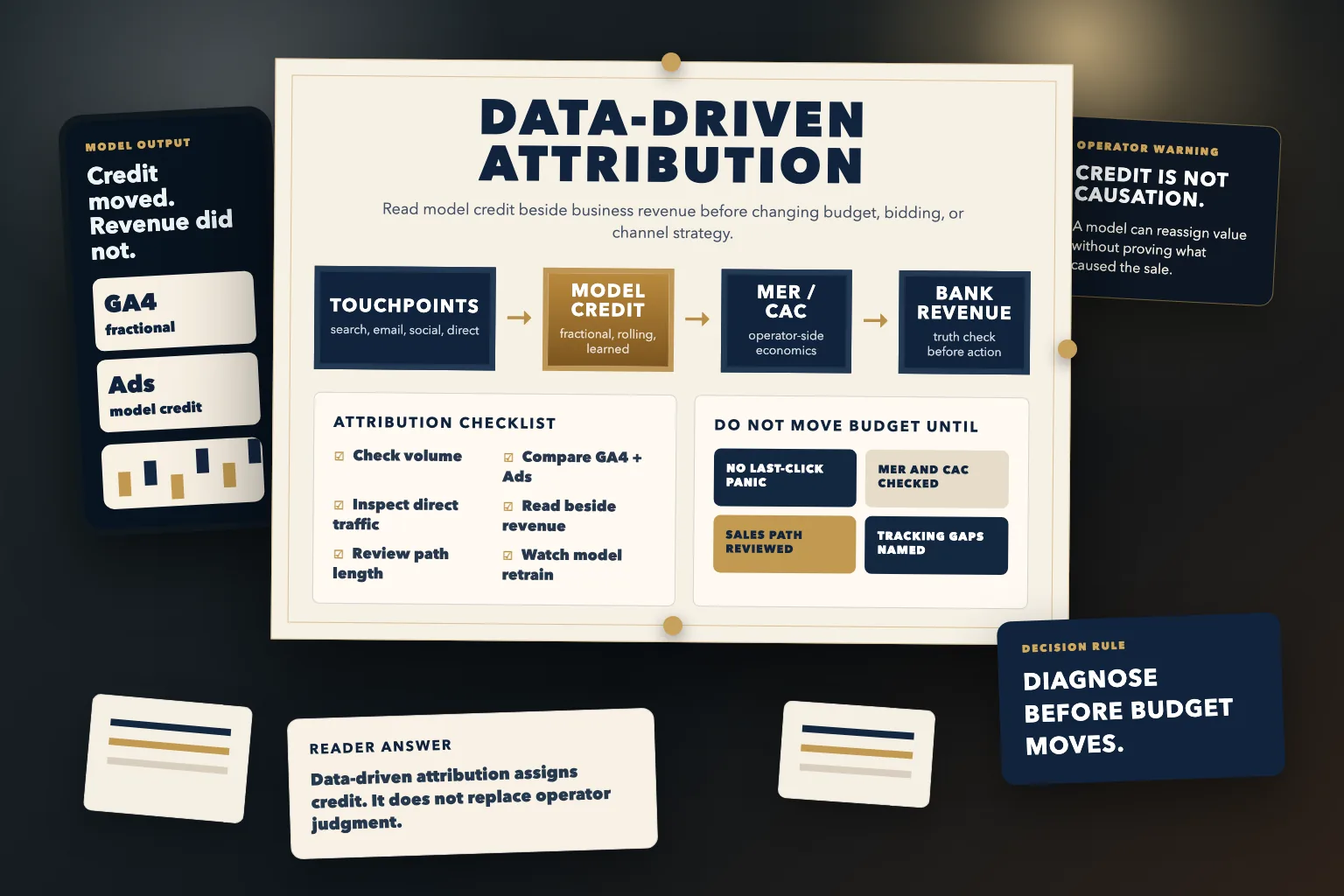
Data-driven attribution uses observed conversion paths to assign fractional credit across marketing touchpoints. Its output can inform budget decisions, but it still needs to be read beside MER, CAC, direct traffic, and recorded revenue.
Data-driven attribution decision guide
Short answer: data-driven attribution uses observed paths and a product-specific model to distribute conversion credit. Google Ads and Google Analytics apply attribution within different reporting and channel scopes. A model can help compare touchpoints, but it does not prove the incremental revenue caused by a channel.
The selected model applies to the conversion action and can affect the conversion columns used by automated bidding.
GA4 attribution reports can compare data-driven and last-click models, with their own channel and reporting rules.
Use recorded revenue, margin, acquisition cost, sales lag, experiments, geographic tests, and holdouts when the decision requires causal confidence.
Do not move budget because a model reassigned credit once. Confirm conversion definitions, path coverage, consent and tagging gaps, offline-upload timing, model scope, volume, and whether the business outcome moved.
Commercial bridge
Reference use: Numbers, tracking, or dashboards do not match what the business sees in revenue. The owner may fund the wrong move because model credit moved while the money path did not. Keep this as an authority reference, then use the decision view to decide the next check.
| Concept signal | Business problem | Next checks | Next step |
|---|---|---|---|
| Symptom match | Numbers, tracking, or dashboards do not match what the business sees in revenue. | Compare the concept to the visible business symptom before changing the channel, page, or budget. | Open the problem |
| Proof need | The idea needs evidence before it becomes a work order. | Review the closest proof file for the same failure pattern. | Review proof |
| Execution lane | The failing layer appears specific enough to scope work. | Use the service page only when the constraint is named. | See the service |
| Unknown layer | The account, site, offer, tracking, or follow-up path may still be the constraint. | Get the Written marketing plan before another rebuild, retainer, or budget increase. | Request a quote |
The numbers underneath
Section 01 · Quick definition
Direct answer
Data-driven attribution is a machine-learning attribution model used by Google tracking systems to assign fractional credit to each touchpoint on a conversion path. It uses observed conversion data to estimate which interactions contributed to the outcome and distributes credit accordingly.
The operator review
The model output looks like attribution, but it is learned credit, not measured cause. The operator sees credited revenue per channel and not the full math behind the credit, so the output must be checked against MER, CAC, direct traffic, path length, and actual revenue.
Section 02 · Why it matters
Origin.
Data-driven attribution is closer to the truth than last-click for any business with a multi-touch buyer path, and it is harder to defend in front of a CFO who wants a clean attribution narrative. The CFO sees credit shifting between channels quarter to quarter and asks why. The model retrained. The conversion volume changed. The path mix shifted. None of those answers settle a budget conversation. The model is an improvement in fidelity at the cost of a story.
Mechanic.
The metric matters because it sits underneath every Smart Bidding decision, every channel performance dashboard, and every conversation about which marketing investments are working. An operator who does not understand what data-driven attribution is doing cannot parse the dashboard and cannot question what the bidding algorithm is optimizing toward.
The practical stake is that data-driven attribution rewards the channels with the strongest learned contribution and penalizes channels with sparse data. The penalty is not always deserved, and the reward is not always proportional.
Section 03 · How it runs
Data-driven attribution trains on the property's observed conversion paths and the paths of users who did not convert. It learns the lift each touchpoint contributed by comparing converting paths to non-converting paths with similar structure. The output is a fractional credit per touchpoint that sums to one across the path. The model retrains on a rolling basis using recent conversion data, so the credit assigned today is not necessarily the credit the same path would have received six weeks ago.
The model consumes the user's sequence of touchpoints on the way to a conversion: source, medium, campaign, and event timestamps. Untagged or direct sessions can still affect how the path is assessed.
The model compares paths that converted to similar paths that did not. The lift attributed to a touchpoint is roughly the difference in conversion probability between paths that included it and paths that did not. The math is approximate; the spirit is causal.
The model needs enough conversion volume to train. Low-volume properties can make the output look precise while the underlying credit assignment is noisy.
Model or input changes can shift channel credit. Check attribution windows, configuration, consent, identity, event inputs, model changes, refunds, and buyer-path changes before assigning the drift.
The shift this concept names
Before applying this concept
“Data-driven attribution is causal. The model knows what drove the sale.”
After applying this concept
Model or input changes can shift channel credit. Check attribution windows, configuration, consent, identity, event inputs, model changes, refunds, and buyer-path changes before assigning the drift.
Section 04 · Common misunderstandings
Misunderstanding 01
“Data-driven attribution is causal. The model knows what drove the sale.”
The model is correlational with a counterfactual flavor. It does not run experiments and cannot establish causation. It learns which touchpoint patterns predict conversions on this specific property and assigns credit accordingly. That is useful and not the same as knowing what caused what.
Misunderstanding 02
“If we have a small store, data-driven attribution still works for us.”
On low conversion volume, the model can assign credit with high variance. The claimed numbers can look authoritative while still being noisy. Small stores and low-volume lead funnels should assess the model beside MER, CAC, path data, and known source quality.
Misunderstanding 03
“Data-driven attribution is fair to all channels because it's machine learning.”
The model is structurally biased toward channels with strong observability and frequent visibility on the path. Branded search and direct traffic both inherit credit that originated upstream in display, social, or organic. The bias is built into the data the model trains on, not the algorithm itself.
Misunderstanding 04
“The model output is the same in GA4 and Google Ads, so the numbers should match.”
GA4 and Google Ads each run their own data-driven attribution model on different scope: GA4 sees web and app sessions; Ads sees ad impressions and clicks. The two models train on different data and produce different credit. Differences are normal and structural.
Misunderstanding 05
“If we switch from data-driven to last-click, we'll see what really drives conversions.”
Last-click does not show what drove conversions. It shows which channel happened to be visited last. For brands with branded-search closing inheritance, last-click systematically over-credits paid search. For brands with email closing inheritance, last-click over-credits email. Neither model shows truth. Both show different stories.
Section 05 · Questions to ask
Use these checks before changing budget, bidding, channel mix, or page strategy because attribution credit moved.
Does the property have enough conversion volume for stable data-driven attribution training, or is the output likely noisy?
How has channel-level credit shifted in the last four quarters, and how much of that shift is model retrain versus underlying behavior change?
Which channels are gaining credit that was previously elsewhere, and which are losing it?
Is data-driven attribution being used to import conversions into Google Ads for Smart Bidding, and how does the imported credit compare to the platform-native count?
How has the share of direct traffic moved alongside the model retrain, and is direct absorbing credit that should belong to a tagged channel?
Are the data-driven attribution numbers being checked against a benchmark or against the operator's own historical baseline at fixed mix?
Are conversion paths longer or shorter than they were 12 months ago, and does the model handle the new path length correctly?
Stan's take · four points
Data-driven attribution is closer to truth than last-click and harder to defend in front of a CFO.
I have lost time in budget meetings explaining why a channel that drove 32% of revenue last quarter drove 24% this quarter without anything underneath the channel changing.
The answer is the model retrained on the property's recent path data and reweighted credit.
The CFO does not want that answer. The CFO wants a number that does not move because the math moved. There isn't one. The honest assessment is that data-driven attribution is the best learned credit available, and learned credit is not the same thing as a bank statement, and the operator who pretends otherwise is going to lose budget conversations they should win.
Section 06 · Adjacent concepts
Use this when the attribution question is really a buyer-stage guidance question: attention, interest, desire, action, and the page that should own each move.
Open conceptUse this when answer engines are part of the path and the business needs AI-clear stages, not only channel credit.
Open conceptSection 07 · Sources
Official documentation on how data-driven attribution distributes credit, the data volume required for stable training, and how the model treats cookieless and direct paths.
Reference for how data-driven attribution functions inside Google Ads, including how it interacts with Smart Bidding and conversion imports.
Trade press coverage of Google's 2023 default-model change and the tracking implications for operators.
Official explanation of how Google Ads attribution models assign conversion credit across ad interactions.
Useful background on multi-touch attribution concepts and why attribution models should inform decisions without pretending to be perfect causal proof.