



01
Paid traffic architecture
Campaign structure across Google, Meta, and supporting platforms. Brand exclusion default, audience signal sharpened, creative-PDP alignment, tracking integrity verified.
Home / Services / Marketing System Build
Stan Consulting service
Use this only when the marketing audit shows ads, website or store, tracking, reporting, follow-up, and owner decisions have to be rebuilt together. SC ships the connected commercial system across 60 to 120 days. Implementation included. Priced after the marketing audit.
Reviewed by Stan Tscherenkow Last Reviewed June 16, 2026

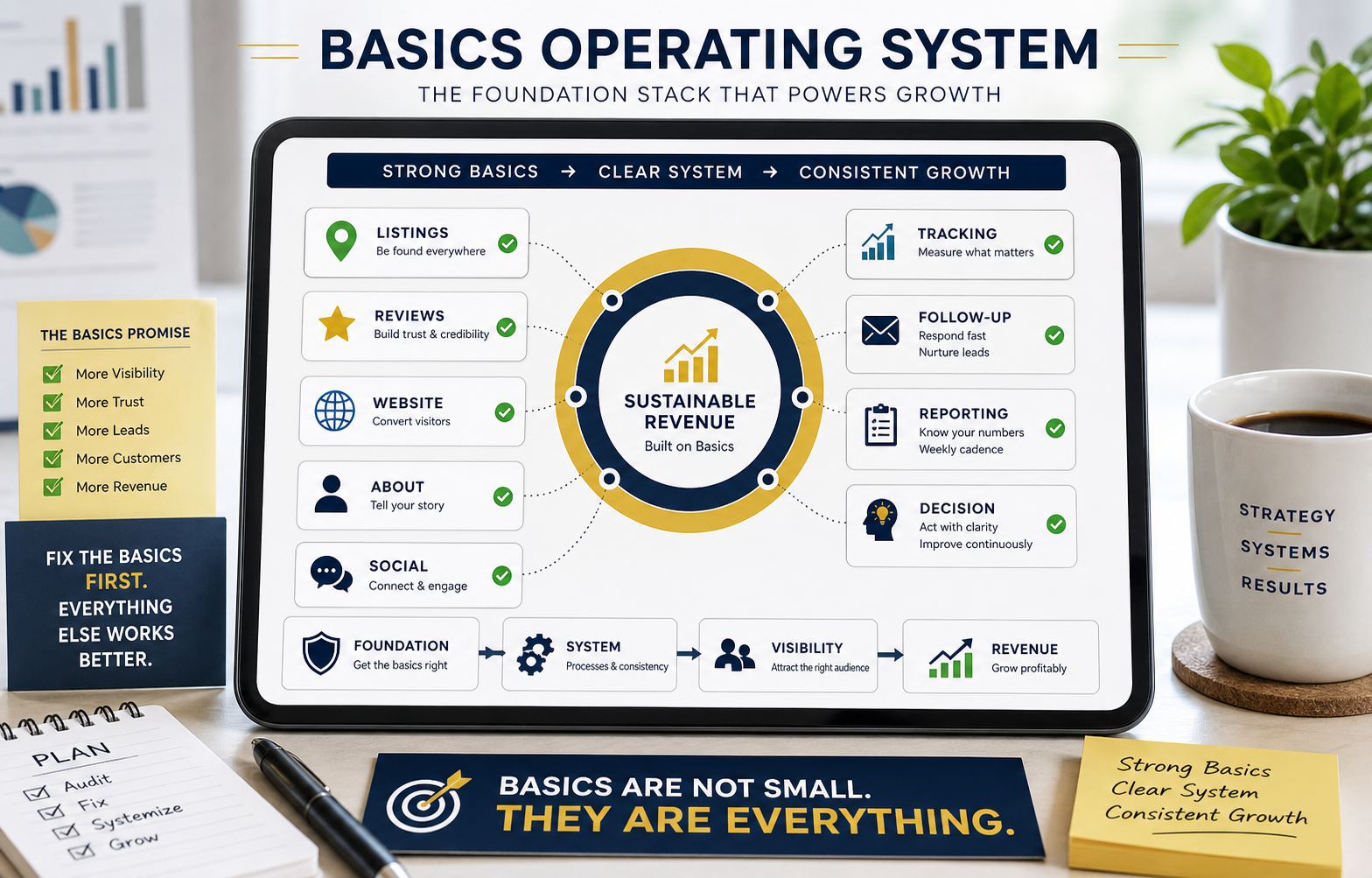
Basics before the build
The build works only when the business is legible: profiles claimed, reviews watched, data trusted, offer clear, and follow-up owned. Otherwise the new system only moves confusion faster.
Before ads, social, email, or a new website get rebuilt, SC checks the foundation that most businesses ignore because it is not flashy.

Buy a campaign. Buy a page. Buy a summary. Ask three vendors why the numbers still disagree.
Name the leak first. Rebuild only the connected handoffs that stop revenue from becoming clear.
The expensive mistake is buying a full build when the actual failure is one weak handoff. The second mistake is buying one narrow fix when the handoffs are the failure.
Audit Sequence Build
The first decision is not what to buy. The first decision is whether the sales path needs one contained repair or one connected rebuild.

buyer decision
Use this when the account, page, tracking, and follow-up need to be rebuilt together. If the real problem is still uncertain, send the build context before buying a build.
Key takeaways
Offer clarity
Marketing System Build is for companies whose ads, website, store, tracking, reporting, follow-up, and owner decisions have to be rebuilt as one sales path. It is not the first move when the real problem is unknown.
The scope is set by the marketing audit: what gets built, what gets repaired, what stays in place, and what the owner should measure after handoff.
The framework
01
Campaign structure across Google, Meta, and supporting platforms. Brand exclusion default, audience signal sharpened, creative-PDP alignment, tracking integrity verified.
02
Website, PDP, cart, checkout, form, follow-up rebuilt as one coherent path. Friction layers audited and fixed. Mobile-first.
03
GA4 enhanced ecommerce, Pixel + CAPI deduped, server-side fallback, offline sales import for offline conversions. Bank-account variance documented.
04
Voice consistency across surfaces (website, social, third-party directories, vendor pitches). Entity signal cleaned for AI citation.
05
Organization and Service schema, llms.txt, ai.txt, FAQPage markup, answer-shaped content. AI assistants can cite the business cleanly.
06
Monthly review structure documented. Decision log live. Owner cadence matches the decision cycle, not the platform refresh rate.
The method behind every engagement
Stan Consulting reviews the page, ad account, tracking, offer, and follow-up so marketing work starts from the right evidence.
Landing page, message order, trust proof, and next action.
Ad platform, campaign setup, landing path, and spend.
Tracking, attribution, the actual revenue trail.
What is being sold, the price, the proof.
What happens after the click, the form, the call.


Visual marketing audit
This work is for moments where the wrong next move is expensive. Stan Consulting reviews the situation, names the constraint, and gives the owner a cleaner sequence.
Simple process
Share the web address, campaign, store, page, or decision that should be producing calls, quote requests, purchases, booked work, or cleaner owner decisions.
Stan Consulting reviews the situation and points the request to the right paid scope: review, repair, consulting, build, or marketing services.
You get the next action, owner decision, and implementation sequence without a vague exploratory call.
Decision lens
| Axis | Marketing System Build | Multi-vendor retainer | Fractional CMO + agency |
|---|---|---|---|
| Scope | End-to-end system rebuild | Channel by channel | CMO oversight + agency execution |
| Output | Coherent system shipped + measurement baseline | Activity across multiple retainers | Operating leadership + executed campaigns |
| Duration | 60-120 days | Ongoing, no defined end | Multi-year typical |
| Cost | Scoped after marketing audit one-time | $8K-$40K/month combined | $10K-$25K/month + agency costs |
| Best when | System itself is the constraint | Specific channels need management | Long-term operating leadership needed |
| Risk | Lower (fixed scope, named outcome) | Higher (multiple retainers, coordination overhead) | Higher (multi-year commitment, alignment risk) |
| Lock-in | None. Build ends at handoff. | Multi-month minimums typical | Multi-year typical |
Why buyers trust the page
Single-channel changes improve one surface. System build aligns the channel, page, attribution, handoff, and tracking cadence so the owner can see one commercial path.
Not a strategy document handed to an in-house team. The build ships the working system. Strategy plus execution in one engagement.
Build scope is set after the current marketing evidence is reviewed. Layers that need rebuild are flagged; smaller fixes step to Sprint or in-house.
Questions before contact
It is for companies whose ads, website, store, tracking, reporting, follow-up, and owner decisions need to work together. If there is no live offer, page, campaign, store, or decision yet, start with the request path so the request can be scoped correctly.
You get offer path, website or store structure, tracking, reporting, owner handoff, plus the next action that should happen first.
Scoped after marketing audit is the visible starting point or pricing band for this service. Variable work is priced after the asset, account, timeline, and owner involvement are clear.
Build timeline after review. Response comes through the intake path after the context is submitted.
Not as the first move. Submit the situation first so the conversation starts with the real page, campaign, store, or decision instead of a blank sales call.
That is common. The work can review the current setup, direct the internal team, or define what the outside vendor should fix first.
Yes. Build engagements without current marketing evidence can turn into expensive guesswork. The build scope starts after the account, page, tracking, follow-up, and revenue constraint are clear.
Sprint is 30-day fixed-scope on a single layer. Build is 60-120 days across multiple layers. Marketing Audit determines which fits; some operators do a Sprint first, then a Build.
Creative direction yes; creative production sits with partner operators (designers, video, copy) for specific build types. The Build scope names which partner before the engagement starts.
Build engagements coordinate with existing vendors where they continue to operate. The Build either replaces the failing layer or aligns the existing vendors against the new system architecture. Vendor exit is handled honestly when warranted.
Schema markup, llms.txt, ai.txt, FAQPage, answer-shaped content, third-party citations. The structural work that lets AI assistants cite the business cleanly. Required for businesses where AI search is part of the buyer journey (most business-to-business services and ecommerce now).
External references
This service answers these pains
Build decision
Short answer: Build is the right move when the evidence shows a connected failure across ads, page, store, tracking, follow-up, or tracking. If the business only knows the symptom, the build review request comes first.
| Build signal | What it means | What not to build yet | Money risk |
|---|---|---|---|
| Ads, site, tracking, and follow-up all disagree | The business may not have one clear sales path. | Do not rebuild the website alone if tracking or follow-up is also broken. | Single-layer fixes keep moving the failure around. |
| The system depends on multiple vendors | Handoffs may fail because nobody owns the full path. | Do not add another vendor before ownership is clear. | Qualified demand drops between tools, teams, and numbers. |
| The cause is still unknown | The business has a symptom, not a build scope. | Do not buy a 60-120 day build from guesswork. | The wrong build makes the real cause harder to see. |
Start with the buyer problem this service should solve. Open the matching problem.
System architecture proof shows the kind of marketing evidence a buyer should inspect before the next spend decision. This step is proof-gated: the page should not claim more than the available result file supports. Open the proof.
If the failure crosses more than one layer, move the decision through the build review request before implementation. Start the build review.
Fit check
Marketing System Build for Ads, Website, Tracking, and Follow-Up is worth requesting when there is a live page, account, store, offer, tracking setup, or follow-up path to inspect.
The company has real demand, budget, or traffic, and can change the page, offer, proof, tracking, follow-up, or spend logic.
Marketing System Build for Ads, Website, Tracking, and Follow-Up: numbers and meetings help only when the page, account, store, or intake problem is named.
The web address, the offer, the ad or search source, the sales action that should happen, and what currently happens instead.
Send the current system, marketing audit context, and revenue target. SC scopes a build only when the evidence shows the path needs to be rebuilt together.
Start build review